Dark Flow: A Mysterious Force From Outside of our Local Universe

Credit: NASA/Goddard/A. Kashlinsky, et al.
The universe is far stranger than anything we can truly contemplate. From the big bang, black holes, dark matter, giant diamond stars and exoplanets coated in burning ice, one truly doesn’t have to look too far to find something each of us find mind-boggling or hard to comprehend. On today’s list of W-T-F, is a relatively new cosmic phenomena called dark flow. (I again, find it kind of ironic that we use the word ‘dark’ so often. Each time it usually means ‘we have no idea, really.’)
The “Observable” Universe
Anyhow, the actual universe is divided into two parts. First, there is the ‘observable’ universe, which spans approximately 93 billion light-years in diameter and then we have the actual universe, which has no set diameter, as there is still quite a big debate brewing in the scientific community concerning whether or not the universe is finite or infinite. We may never know, as we can only see light from distant objects that have had the time to travel from its original position to our own planet, which limits exactly how much we can see of the universe. One can argue that based on its flat geometry, it continues infinitely in all directions, just as we are hindered by the sea’s horizon as we gaze out in all directions here on Earth, but despite this, we know something more exists beyond our cosmic horizon, we are just unable to detect exactly what lies just beyond it.

However though, gravity is a strange beast, albeit, a useful one to us here on Earth because it provides certain clues to the existence of objects that are very small, difficult to spot, or perhaps even invisible entirely (like black holes). Rocky Earth-like exoplanets are a good example of this. Most we’ve discovered thus far were found through the radial velocity method, which observes tell-tell ‘wobbles’ that happen as a planet tugs on its parent star. It is through that same phenomena that we are able to determine there is more beyond the scope of what we can see since gravity is still applicable on a large-scale in the universe, just as it is on a small-scale.
The ‘Dark Flow’ Cosmic Quandary
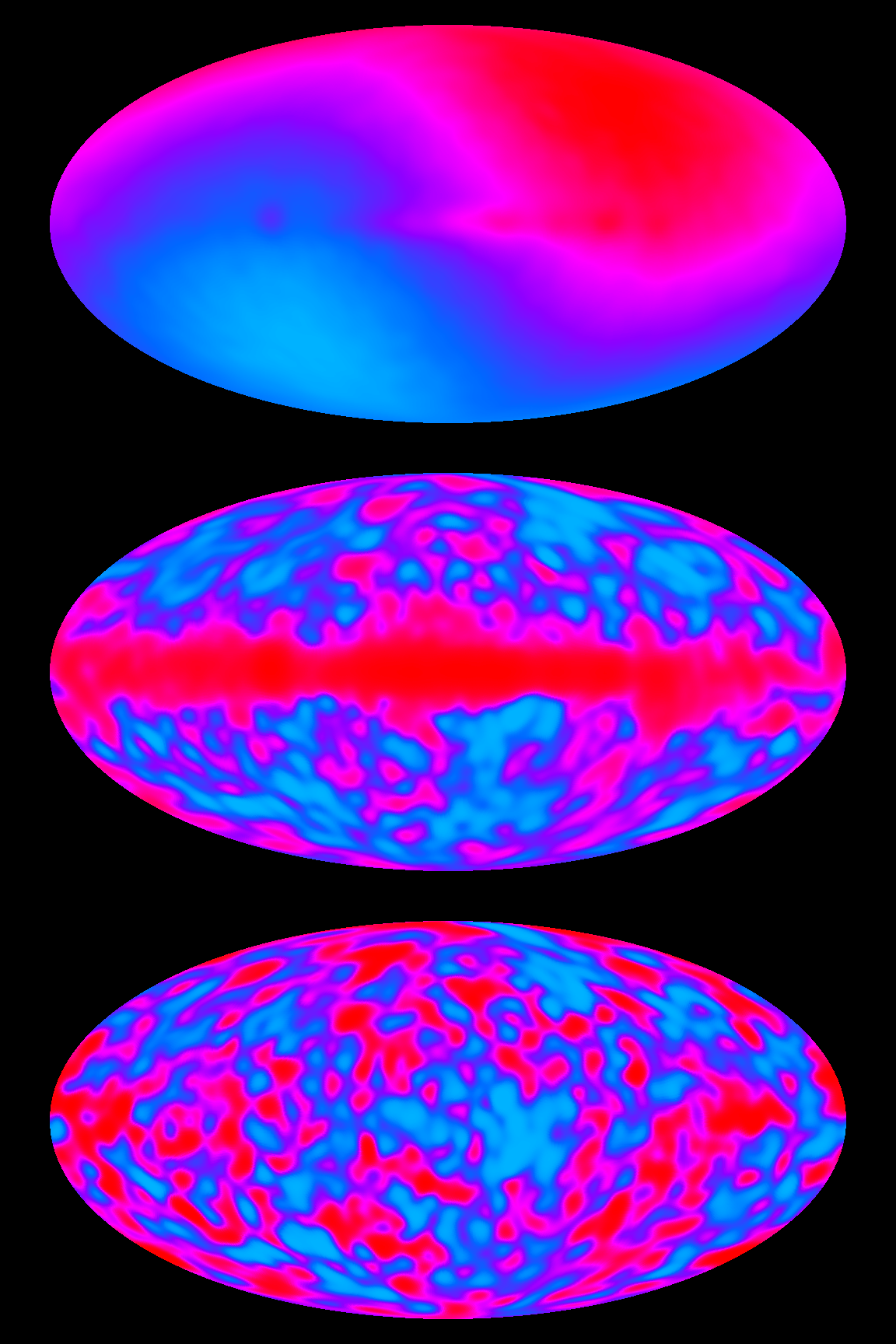
NASA’s Wilkinson Microwave Anisotropy Probe’s (WMAP) spent an entire three years studying the universe’s cosmic microwave background radiation, which is the remnants from the radiation created only 380,000 years after the big bang, along with developing a catalog of deep space clusters. Some of which, are more than 3 billion light-years from Earth. When scouring through the data collected, the team spotted out more than one hundred galaxy clusters that are lit up by hot, x-ray emitting gases. Our theories on the CMB basically says that the waves that sprung from the big bang should pass through said galaxy clusters and change in predictable ways under certain scenarios, including if the galaxy is moving relative to the background glow. This was developed to test this, known as kinematic Sunyaev-Zel’dovich (SV) effect, but physicists found something else altogether that brought more questions to light than it answered.
What did they find?
The clusters are traveling more than 2 million miles per hour, into an expanse of about 20-degrees of sky into a line from our solar system, to the constellations of Centaurus and Hydra. Furthermore, the trend is not a statistical fluke, as it continues to hold steady throughout interstellar space instead of bucking black to normal speeds and distributions. “It’s the same flow at a distance of a hundred million light-years as it is at 2.5 billion light-years and it points in the same direction and the same amplitude. It looks like the entire matter of the universe is moving from one direction to the next,” says Alexander Kashlinsky, the team leader of the study from NASA’s Goddard Space Flight Center in Greenbelt, Maryland.

What does it mean?
This baffling observation suggests that something created only a fraction of a second after the big bang (moments before inflation, when the universe began to expand outward at incredible speeds) is involved, exerting a gravitational force on the clusters from just beyond the scope of our observable universe, but what? “We can only say with certainty that somewhere very far away the world is very different than what we see locally. Whether it’s ‘another universe’ or a different fabric of space-time we don’t know,” Kashlinsky continued.
One theory put forth about the observations fits theoretical models purported by string theory, of how a ‘sister’ or ‘twin’ universe may be pulling at our own, which would account for what we’re observing with the clusters traveling so quickly. Regardless, the structure is not thought to be a part of our own simply because we haven’t observed anything that could have an immeasurable mass to accomplish anything similar to what we’re observing here. It is possible though, that there is a yet-to-be-seen neighboring part of our universe that underwent inflation much differently than our section did. Interestingly, maybe the answer to this riddle could potentially overhaul our theories about dark matter and dark energy, perhaps? It’s hard to say, but it does present some interesting questions.

“If our universe is all that’s there, then the liquid in the box shouldn’t be sliding. Whatever is pulling it has to be bigger than the size of the box,” she said. “There is a structure beyond the horizon of our universe and that structure is exerting a force on our universe and creating this flow.”

No comments:
Post a Comment